
What if your local community hall or intimate basement stage could mirror the atmospheric depth of a top-tier theatrical production without tripping a single circuit breaker? You likely understand the struggle of working in cramped spaces where antiquated fixtures pump out stifling heat and the scarcity of UK power outlets feels like a constant battle against physics. Achieving professional stage lighting for small venues often feels like a compromise between your creative vision and the physical reality of a tiny room.
It's time to stop letting your floor space dictate your production value. You'll soon discover how to transform even the most modest performance areas into immersive environments using curated, energy-efficient LED strategies that balance sophisticated aesthetics with practical ease of use. We'll explore the compact rigs that fit comfortably in a car and the clever "wash" techniques that ensure your performers look stunning on camera whilst keeping your energy bills in check. From understanding the latest 2026 control standards to selecting fixtures that offer maximum impact with a minimal footprint, this guide provides the roadmap to elevate your venue's atmosphere.
Key Takeaways
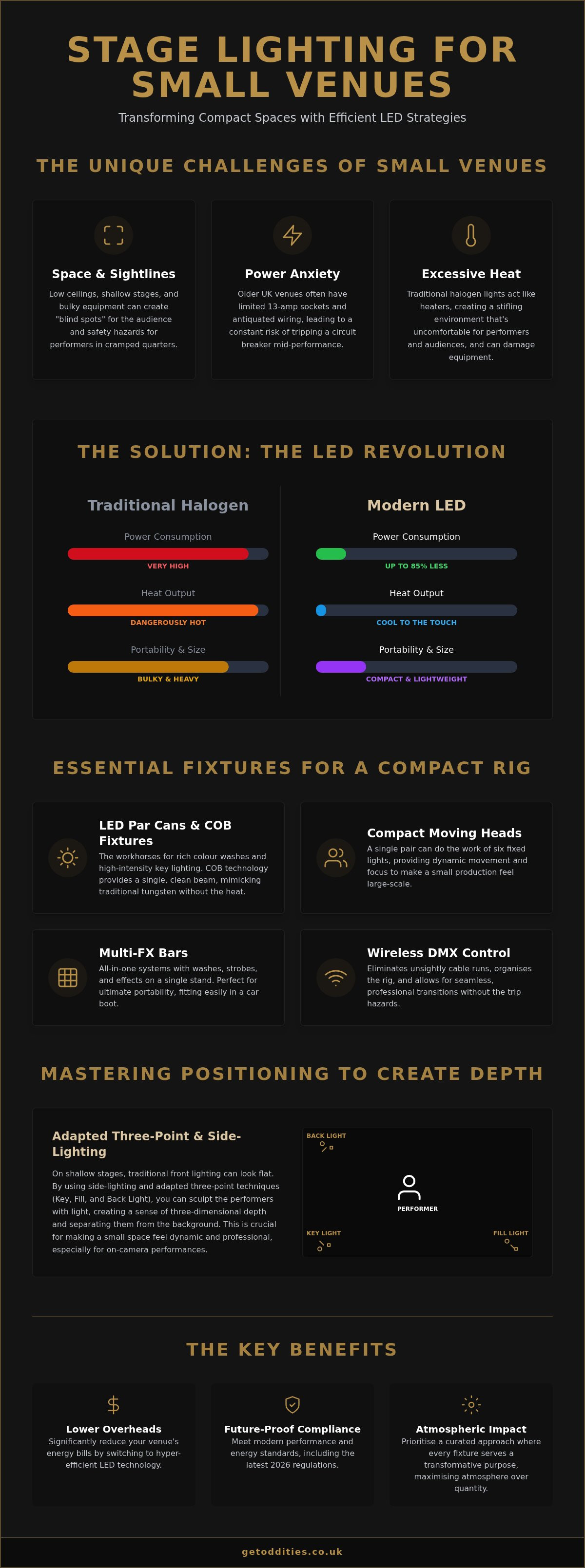
- Swap traditional halogen fixtures for COB and LED Par Cans to significantly reduce heat output whilst maintaining a high-intensity, professional glow.
- Utilise adapted three-point lighting and side-lighting techniques to create a sense of three-dimensional depth on cramped or shallow stages.
- Transition to Wireless DMX control to eliminate unsightly cable runs and organise your rig for seamless, professional transitions.
- Implement energy-efficient stage lighting for small venues to lower your venue's overheads and comply with the latest 2026 performance standards.
- Choose a curated approach to lighting that prioritises atmospheric impact over quantity, ensuring every fixture serves a specific transformative purpose.
The Unique Challenges of Lighting Small Performance Spaces
Small stages offer a raw, electric intimacy that larger theatres simply cannot replicate. This proximity between the artist and the audience creates a shared energy, but it also brings a specific set of logistical hurdles that can ruin a production if ignored. Transforming a compact room into a professional performance space requires more than just scaling down a large rig. It demands a curated approach where every fixture is chosen for its ability to perform in tight quarters without overwhelming the senses. The foundation of effective stage lighting for small venues lies in understanding that you aren't just illuminating a performer; you're managing an environment where every centimetre of space and every watt of power counts.
In many historic or repurposed UK venues, you're often restricted by the architecture itself. Low ceilings and shallow stages mean that traditional Stage lighting setups, which rely on distance to throw light effectively, often fail. When a fixture is only two metres from a performer's face, the margin for error disappears. You must balance the need for atmospheric depth with the reality of limited mounting points and the ever-present constraint of standard 13-amp power sockets.
Space Constraints and Sightlines
When the front row sits within arm's reach of the stage, bulky equipment becomes a physical barrier. Large tripods and oversized lanterns create "blind spots" that obscure the view for guests, particularly those seated at the sides. You need low-profile fixtures that provide high-impact illumination whilst remaining virtually invisible. Strategic placement is equally vital for safety. In high-traffic zones where performers and staff move in cramped quarters, keeping cables organised and tucked away is essential to prevent accidents and maintain a clean, professional aesthetic that doesn't distract from the show.
The Shift to LED Efficiency
Traditional halogen par cans are a genuine liability in small rooms. They act as high-powered heaters, quickly turning a basement or back-room stage into a stifling environment. This leads to "stage sweat," which isn't just uncomfortable for the artist; it can actually damage sensitive instruments and ruin the audience's comfort. LED fixtures have revolutionised stage lighting for small venues by offering a negligible thermal footprint. Because they stay cool to the touch, you can place them closer to curtains and performers without risk.
Energy efficiency also solves the "power anxiety" common in older buildings. A standard UK ring main can only handle so much before a circuit trips. By switching to LED, you can run a sophisticated, multi-layered rig that draws less power than a single traditional kettle. This reliability allows you to focus on the creative side of the performance rather than worrying about the fuse box mid-set.
Essential Lighting Fixtures for Compact Stages
Selection is everything in a space where every square inch is precious. You cannot afford "filler" fixtures that take up room without earning their keep. Choosing the right tools for stage lighting for small venues is an exercise in intentionality; you're selecting the brushstrokes for a transformative environment. LED Par Cans remain the essential workhorse, providing rich, saturated colour washes that can instantly shift a room's emotional temperature. For venues where storage is a luxury you simply don't have, the Multi-FX bar is a revelation. These all-in-one systems combine washes, strobes, and even lasers on a single stand, allowing you to strike the entire rig in minutes and tuck it away into a small cupboard or a car boot.
Innovation has also brought us COB (Chip on Board) technology, which offers high-intensity output from a remarkably small footprint. Unlike older LEDs that produce multiple distracting shadows, COB fixtures create a single, clean beam that mimics the natural feel of traditional tungsten whilst remaining cool to the touch. If you need dynamic energy, a pair of compact moving heads can do the work of six fixed units. They provide movement and focus that draws the eye, ensuring your production feels large-scale even when the stage is only three metres wide. If you're looking to upgrade your setup, exploring a curated collection of LED fixtures can help you find that perfect balance between power and portability.
The Power of the LED Wash
A smooth colour wash is the foundation of your design. It fills the gaps and hides the imperfections of a basic stage. When choosing your fixtures, look for RGBAW+UV chips. The addition of Amber, White, and Ultraviolet allows for more natural skin tones and deep, evocative purples that standard RGB lights can't replicate. Understanding these technical nuances is part of mastering the Basics of Good Stage Lighting Design, where the goal is to guide the audience's eye without them ever noticing the hardware. To make a narrow stage feel significantly wider, try "splashing" your wash lights against the side walls rather than just the floor.
Spotlights and Profile Fixtures
Precision is your best friend in close quarters. You need to highlight the lead performer without "spilling" light onto the front row, which can break the fourth wall and make guests feel exposed. Compact profile spots allow for precise beam control, using shutters to crop the light exactly where it's needed. You can also use "Gobos" (small metal or glass discs) to project textures like leafy patterns or geometric shapes onto plain venue walls. This simple trick adds layers of professional depth to a flat space, making a bland room feel like a bespoke set.
Mastering the Art of Positioning: Creating Depth
Depth is the silent narrator of any professional performance. In smaller spaces, the temptation is often to simply blast light from the front to ensure visibility, but this approach is the quickest way to make a stage look amateurish and flat. By thoughtfully sculpting the space with light, you can create the illusion of a much larger environment. Effective stage lighting for small venues relies on the strategic use of angles to separate the artist from their surroundings, turning a cramped corner into a three-dimensional world.
The secret to professional-grade depth lies in backlighting and side lighting. A single fixture placed behind the performer, angled down from a high point, creates a "halo" effect that separates them from the back wall. Side lighting, meanwhile, defines the silhouette and adds a sense of drama that front-on lighting simply cannot achieve. When you combine these elements, you're essentially Designing and Focussing a General Cover that looks as good to the naked eye as it does through a camera lens. This layered approach ensures that even when space is at a premium, your production feels expansive and intentional.
Angles and Elevation
Finding the "sweet spot" for facial illumination usually involves the 45-degree rule. Positioning your primary front lights 45 degrees up and 45 degrees to the side provides natural shadows that define the performer's features without blinding them. If your venue lacks ceiling rig points, don't despair. Floor-mounted "uplighting" can be a transformative alternative, casting long, evocative shadows that add height to a room. In venues with extremely low ceilings, you'll need to be mindful of light spill; use barn doors or shutters to keep the focus on the artist rather than the rafters.
Colour Theory for Mood and Atmosphere
Colour is your most potent tool for setting the emotional tone of a show. Cool blues suggest mystery, night-time, or melancholy, whilst warm ambers evoke a sense of intimacy and comfort. The psychology of colour allows you to match the lighting to the musical genre or the intensity of a scene with surgical precision. Deeply saturated colours can effectively mask a venue's physical flaws by drawing the eye toward the vibrant light and away from scuffed walls or unsightly pipes. By curating your palette, you transform a mundane room into a purposeful sanctuary for art.
Control and Energy Efficiency: Reducing Venue Overheads
Control is the bridge between having equipment and having a show. In the context of stage lighting for small venues, managing your rig shouldn't feel like a full-time job. DMX (Digital Multiplex) is the industry standard that allows you to organise your fixtures into a cohesive system. By assigning each light a specific "address," you gain the power to dim, change colours, or trigger effects from a single point. This level of control ensures your transitions are seamless rather than jarring, allowing the lighting to ebb and flow with the performance.
The traditional "cable jungle" is a significant hurdle in compact spaces where floor area is at a premium. Wireless DMX has emerged as a transformative solution, eliminating the need for long, unsightly data cables snaking across the venue. This technology allows you to send signals through the air, preserving the aesthetic of your space and reducing setup time. For venues that don't have a dedicated lighting technician, "Sound-to-Light" modes provide a professional, reactive look by synchronising your fixtures with the rhythm of the music automatically.
Simplifying the Setup
You don't always need a massive console to achieve a professional result. Smartphone apps and tablet-based controllers have made sophisticated programming accessible to everyone. If you prefer a "set and forget" approach, Master/Slave configurations allow one primary fixture to dictate the behaviour of the entire rig with zero programming required. Pre-setting specific scenes for different types of events ensures consistency and removes the stress of live adjustment during a busy show.
Sustainable Performance
By 2026, energy efficiency is a financial necessity for small businesses rather than just an environmental choice. Modern LED fixtures are the only viable option, offering a rated lifetime of over 50,000 hours. A high-efficiency 50W LED fixture typically provides the same luminous intensity as a traditional 500W tungsten par can whilst drawing only a fraction of the electricity. This reduction in wattage translates directly into lower overheads, allowing your LED upgrade to pay for itself through reduced utility bills. To begin your transition to a more efficient and atmospheric rig, you can browse our commercial LED fixtures designed for high-impact performance.
Elevating Your Venue with Oddities Professional Lighting
Atmosphere is the invisible thread that connects a performer to their audience. At Oddities, we believe that professional lighting is the most effective way to weave that connection, turning even the most mundane room into a purposeful sanctuary for creativity. Choosing stage lighting for small venues shouldn't be a process of settling for less. Instead, it's an opportunity to select high-impact, modernist fixtures that look as sophisticated when switched off as they do when casting a vibrant glow across a stage. Our approach focuses on the transformative power of a well-chosen rig, where quality and intentionality always take precedence over sheer volume.
We've positioned ourselves as a knowledgeable guide for venue managers across the United Kingdom who value both aesthetics and efficiency. The Oddities advantage lies in our commitment to a seamless experience. Every item in our collection is chosen for its ability to enhance specific environments, and we've removed the logistical headaches of international sourcing. All UK duties are included in our pricing, allowing you to shop with confidence whilst knowing exactly what your investment will be from the outset. This transparency, combined with our expert-led selection of LED fixtures, ensures you can focus on the art of the performance rather than the complexities of the supply chain.
Why Curation Matters
It's incredibly easy to fall into the "cheap light" trap. Many entry-level fixtures promise high output but deliver inconsistent colours, noisy fans, and a short lifespan that ultimately costs more in replacements. Investing in quality means choosing fixtures that balance professional power with a compact design suited to intimate spaces. By sourcing equipment through our Commercial Stage Lighting UK pillar, you're opting for tools that have been vetted for their reliability and sensory impact. A curated rig doesn't just last longer; it provides the precise control needed to create a world-class experience in a room of any size.
Your Partner in Creative Transformation
Every performance space has a unique personality. Whether you're managing a venue for intimate acoustic sets that require warm, subtle textures or a high-energy DJ booth that demands dynamic movement, your lighting rig must be versatile enough to adapt. We view ourselves as your partner in this creative journey, helping you find the specific rig that fits your venue's physical constraints and artistic goals. Finding the right balance between atmospheric depth and ease of use is simple when you have access to the right tools. When you're ready to redefine your space, you can explore our curated collection of stage lighting to find the fixtures that will elevate your next production.
Redefining the Future of Your Performance Space
The journey to a professional-grade atmosphere begins with the intentional selection of every fixture. By prioritising energy-efficient LED technology and mastering the art of positioning, you can transcend the physical limits of your room. You've seen how a few high-impact pieces can replace a cluttered rig, whilst wireless control removes the logistical stress of cramped stages. Implementing these strategies ensures that your stage lighting for small venues is as practical as it is breathtaking.
At Oddities, we curate our collection to ensure every item brings maximum transformative power to your project. We've simplified the process for UK venue managers by including all duties in our pricing, allowing you to focus entirely on your creative vision. Whether you're upgrading an intimate pub stage or a dedicated community centre, our expert-led selection provides the tools you need for a truly professional finish. Elevate your performance with Oddities curated stage lighting and turn every show into an extraordinary experience. Your stage is ready for its transformation.
Frequently Asked Questions
What is the best type of stage lighting for a very small pub stage?
LED Par Cans or all-in-one Multi-FX bars are the most effective choices for cramped pub environments. These fixtures provide a vibrant colour wash without the stifling heat associated with traditional halogen bulbs. Because they're compact, they won't obstruct sightlines in a room with low ceilings. Choosing LED technology ensures your performers stay comfortable whilst you maintain a professional aesthetic on a minimal footprint.
How many lights do I actually need for a small 3-piece band?
A four-light setup is the ideal starting point for a 3-piece band. You'll want two wash lights positioned at the front corners to illuminate faces and two behind the band to create depth and separation from the back wall. This simple configuration provides a professional, three-dimensional look. It ensures every member is visible without cluttering the stage with unnecessary stands and tangled cables.
Can I run a professional lighting rig from a standard UK wall socket?
You can easily run a modern LED rig from a standard UK 13-amp wall socket. Unlike old-fashioned tungsten lamps that draw massive amounts of power, a dozen professional LED fixtures often use less electricity than a domestic kettle. This efficiency makes it safe to operate a full light show in older venues without worrying about overloading the circuit or blowing a fuse mid-performance.
What is DMX and do I need it for a small venue?
DMX is the digital language used to control and synchronise your lighting fixtures from a single console or smartphone app. Whilst it isn't strictly mandatory for a tiny room, it's highly recommended for creating a polished, intentional atmosphere. Without DMX, your lights will simply cycle through colours randomly. Using it allows you to time colour changes with the music, elevating the overall production value of your stage lighting for small venues.
How do I avoid blinding the audience in a compact performance space?
Positioning your lights at a 45-degree downward angle is the most effective way to keep beams out of your guests' eyes. You can also use "barn doors" or "snoots" to physically crop the light and keep it focused strictly on the stage. If the room is particularly tight, consider using frosted filters or diffusion gel to soften the output, creating a warm glow rather than a harsh, direct glare.
What is the difference between a wash light and a spot light?
A wash light provides a wide, soft-edged beam designed to cover large areas of the stage in a consistent colour. In contrast, a spot light produces a narrow, sharp-edged beam used to highlight a specific performer or object. Using a combination of both allows you to set a general mood with the wash whilst drawing the audience's attention to the lead singer with the spot.
How much energy can I save by switching my venue to LED stage lights?
Switching to LED can reduce your lighting energy consumption by up to 90% compared to traditional halogen systems. A single 500W halogen par can be replaced by a 50W LED fixture that provides similar brightness. Over a year of regular performances, these savings on your electricity bill are substantial. The lack of heat also reduces the load on your venue's air conditioning, further lowering your total overheads.
Is it better to buy a few expensive lights or many cheap ones for a small stage?
Investing in a few high-quality fixtures is always a better strategy than buying a large quantity of budget equipment. Premium lights offer better colour mixing, quieter cooling fans, and significantly longer lifespans. On a small stage, every fixture is highly visible, so the superior build quality and smoother dimming of professional-grade gear will be immediately apparent. It's about making a transformative impact with a curated, reliable selection.