
Could the wrong bulb be the reason your carefully designed living room feels more like a clinical waiting room once the sun goes down? It's a common frustration to find that despite beautiful furniture and perfect paint, your indoor lighting is working against you rather than for you. You might struggle with cluttered bedside tables because of poorly sized lamps or feel baffled by the technical jargon of lumens and colour temperatures. We understand that a home should be a sanctuary, not a series of harsh glares and shadows.
Mastering the art of interior illumination is entirely within your reach. This guide will show you how to choose the right fixtures for every room, ensuring your home feels warm, inviting, and expertly curated. We'll explore the essential principles of layering light, moving from functional task lamps for your kitchen to ethereal ambient pieces for your bedroom. By the end, you'll have the confidence to select energy-efficient fixtures that look premium and perform perfectly, transforming your daily environment into something truly extraordinary.
Key Takeaways
- Discover the secrets of light layering to banish flat, uninspiring spaces and create a multi-dimensional sanctuary.
- Master the shift from watts to lumens and understand how colour temperature transforms your indoor lighting from clinical to cosy.
- Learn to choose fixtures with the correct scale and proportion to ensure your chandeliers and bedside lamps complement your room's architecture.
- Identify and avoid common design mistakes, such as the "operating theatre" effect caused by an over-reliance on recessed downlights.
- Explore how to curate a selection of premium materials and energy-efficient LED fixtures that offer both lasting quality and transformative beauty.
The Fundamentals of Indoor Lighting: Creating a Layered Experience
Lighting is the invisible architect of your home. Choosing the right indoor lighting is more than a utility; it's a transformative tool that balances essential visibility with emotional well-being. A room's atmosphere is dictated by how light interacts with surfaces, shadows, and the people within it. When you get this balance right, you elevate a mundane living space into an extraordinary sanctuary that responds to your needs throughout the day. It's about moving beyond the basic requirement of seeing and towards the art of feeling.
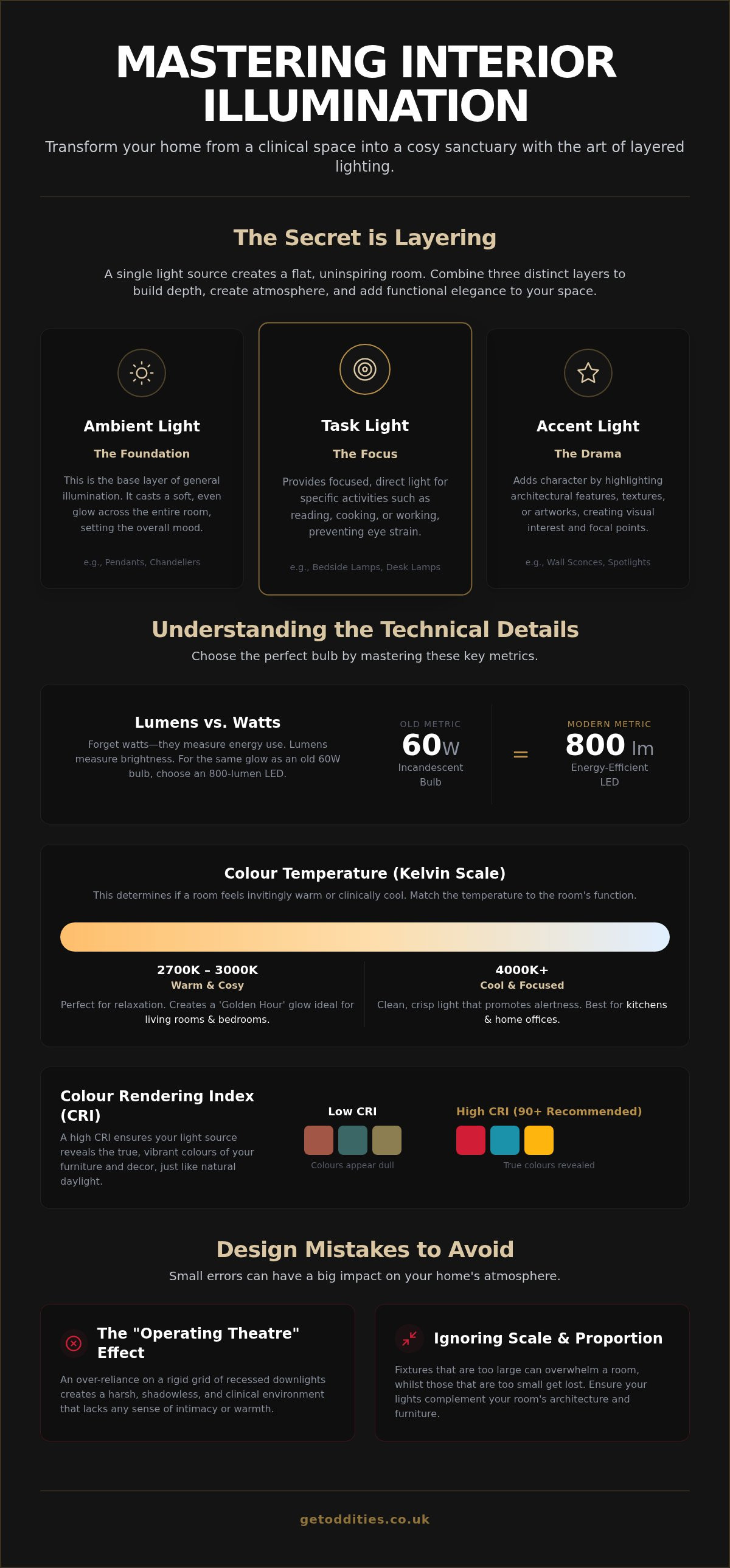
A single ceiling rose is rarely enough for a modern living space. Relying on one central light source creates a flat, uninspiring environment that often feels both harsh and inadequate. To avoid this, successful Architectural lighting design relies on the principle of layering. By combining different types of fixtures, you create depth, interest, and flexibility, allowing you to change the mood of a room at the flick of a switch.
The Three Layers of Light: Ambient, Task, and Accent
The foundation of any well-lit room is ambient lighting. This is your base layer of general illumination, typically provided by elegant pendants or statement chandeliers that cast a broad, soft glow across the entire area. Whilst ambient light sets the stage, it shouldn't work alone. You need task lighting to support specific activities. Think of focused bedside lamps for evening reading or powerful floor lamps positioned over a favourite armchair. These fixtures provide the clarity you need for work or hobbies without over-lighting the rest of the room.
The final layer is accent lighting, which adds drama and character. Wall sconces and spotlights allow you to draw attention to architectural features, textures, or artworks, creating focal points that guide the eye. This layered approach ensures your home remains functional during the day and intimate during the evening.
Why Curation Matters in Interior Design
Intentionality is the hallmark of a designer home. Curation is about more than just picking pretty fixtures; it's about selecting pieces that work in harmony whilst serving a clear purpose. There is a real danger in "over-lighting" a space, which can lead to a clinical atmosphere that loses all sense of intimacy. By choosing a primary focal point, such as a large chandelier made from stainless steel or high-quality polycarbonates, you establish a visual centre around which other elements can orbit.
A curated selection reduces choice paralysis and ensures that every item, from a minimalist floor lamp to an ornate wall sconce, contributes to a cohesive vision. This thoughtful approach to indoor lighting allows you to blend different styles and finishes with confidence, ensuring your home feels both professionally designed and warmly welcoming.
Technical Specifications: Understanding Lumens, Kelvins, and Bulb Types
Choosing the right bulb is as vital as selecting the fixture itself. For decades, we relied on Watts to judge brightness, but in the era of energy-efficient LED fixtures, this is no longer accurate. Watts measure power consumption, whilst Lumens measure actual light output. To replicate the brightness of an old 60W incandescent bulb, you should now look for an LED providing approximately 800 Lumens. This shift allows you to achieve the perfect level of illumination without the excessive energy draw of the past.
Beyond brightness, you must consider how light affects the appearance of your home's textures and tones. The Colour Rendering Index (CRI) is a scale that indicates how faithfully a light source reveals the true colours of your furniture and decor compared to natural sunlight. A high CRI ensures your velvet sofa or oak flooring looks exactly as the designer intended. Applying professional lighting design techniques requires understanding these technical metrics to ensure your indoor lighting enhances, rather than dulls, your interior palette.
The Kelvin Scale: Warm White vs. Cool White
Colour temperature is the most critical factor for evening relaxation. Measured in Kelvins (K), this scale determines whether a room feels inviting or clinical. A range of 2700K to 3000K provides a "Golden Hour" glow that's perfect for bedrooms and living areas. It mimics the soft, amber tones of a sunset, signalling to your brain that it's time to unwind. Conversely, 4000K and above offers a clean, crisp light ideal for home offices or kitchens where productivity is key. You can avoid the "blue light" trap by ensuring your functional spaces are bright but your relaxation zones remain firmly in the warmer spectrum.
LED Efficiency and Longevity
Modern LEDs are a triumph of both form and function. An LED bulb can last between 15,000 and 25,000 hours, which is a staggering improvement over the 1,000-hour lifespan of traditional incandescents. This longevity significantly reduces maintenance and long-term costs. Oddities focuses on energy-efficient indoor lighting options that help reduce home overheads without compromising on a premium aesthetic.
It's also essential to check if your chosen fixtures are dimmable. Dimmable LEDs provide the ultimate mood control, allowing you to transition from bright task work to soft, atmospheric dining with ease. Explore our carefully selected LED fixtures to find the perfect balance of efficiency and style for your next project.
Room-by-Room Guide: Selecting Fixtures for Your Lifestyle
Every corner of your home serves a unique purpose, and your indoor lighting should reflect that. Hallways and entryways are often the most neglected spaces in British homes, yet they provide the crucial first impression for your guests. In narrow corridors where floor space is at a premium, wall sconces offer a sophisticated solution. They provide a rhythmic glow that guides the eye through the home without creating physical clutter. By adding accent lighting to a favourite piece of art or an architectural alcove, you transform a simple transition zone into a curated gallery experience.
The living room requires a different approach, focusing on social connection and versatility. It's often helpful to combine ambient ceiling lights with strategically placed floor lamps. This combination allows you to shift the atmosphere from a bright, family-oriented space to a moody, intimate setting for evening relaxation. The key is to ensure your fixtures work in harmony, using similar finishes or complementary silhouettes to maintain a sense of intentionality throughout the room.
The Bedroom: Designing for Rest and Recovery
Your bedroom should be a personal sanctuary designed for recovery. Lighting plays a central role in this, particularly during the transition between wakefulness and sleep. A common mistake is placing bedside lamps too high or too low; ideally, the bottom of the lampshade should be at eye level whilst you are seated in bed. This placement provides the perfect pool of light for reading without causing glare. We recommend choosing stylish bedside lamps with easily accessible or touch-sensitive switches. This small detail ensures you can extinguish the light without disrupting your relaxed state, helping you maintain a better sleep hygiene routine.
Living and Dining Spaces: Versatility and Drama
In open-plan homes, lighting acts as a subtle boundary. You can use a tall floor lamp to "zone" a reading nook or a seating area, effectively creating a room within a room. This technique adds a sense of structure to large spaces without the need for physical dividers. For the dining room, the focus shifts to the table. A statement pendant or chandelier should be the centrepiece of the social experience, drawing people together. To avoid glare and ensure a clear line of sight across the table, aim for a drop height of approximately 75 to 90 centimetres above the surface.
For those who wish to add an extra layer of depth, incorporating professional stage lighting techniques can create dramatic accenting. By using focused beams to highlight textures or specific objects, you bring a sense of theatre and luxury to your everyday environment. This level of detail is what separates a standard house from a truly curated home.
Design Trends and Common Mistakes to Avoid
The most common error in contemporary homes is the "Operating Theatre" effect. This occurs when a ceiling is saturated with recessed downlights, creating a flat, clinical glare that strips a room of its character. Whilst these lights are functional, they should never be the primary source of indoor lighting. Instead, focus on creating pools of warmth that invite relaxation rather than inspection. Avoiding the "shadow trap" is equally vital; poorly placed fixtures can leave dark corners that make a room feel smaller and less welcoming than intended.
Scale and proportion are the silent partners of successful interior design. A chandelier that is too small for your dining table will look like an afterthought, failing to anchor the space effectively. Conversely, you must manage the "Mixing Metals" challenge with confidence. Brass, chrome, and matte black finishes can live harmoniously amongst your decor if you organise them with intentionality. By repeating a finish in two or three places, you create a cohesive narrative that feels professional rather than accidental. Explore our curated collection of designer fixtures to find pieces that balance these elements perfectly.
Modernist vs. Industrial Aesthetics
Minimalist LED fixtures are the backbone of contemporary UK homes, favouring clean lines and high-quality materials like stainless steel and polycarbonates. These pieces disappear into the architecture whilst providing powerful, efficient illumination. On the other hand, the rise of industrial-style floor lamps and wall sconces brings a robust, tactile energy to urban renovations. The secret is to select a "Statement Piece"; a bold innovator of a fixture that serves as a conversation starter and establishes the room's aesthetic purpose from the moment you enter.
Placement and Installation Tips
Precision in placement transforms a good room into a great one. For wall sconces, aim for a height of 150cm to 160cm from the floor to prevent unflattering shadows on faces and ensure the light is at a comfortable level for the eye. Always engage a qualified electrician for permanent ceiling installations; this ensures your home meets safety standards whilst protecting your investment in premium fixtures. In narrow UK hallways, try directing light onto the walls rather than the floor. This technique makes the space feel wider and more welcoming, turning a cramped passage into an inviting transition.
Discover the Oddities Collection: Premium Indoor Lighting
Transforming your home shouldn't be a journey through endless, uninspiring catalogues. At Oddities, we believe in curation over clutter. Our collection focuses on ten key indoor lighting styles, each selected for its ability to elevate a room from the ordinary to the extraordinary. We've removed the noise of choice paralysis, presenting only those pieces that meet our exacting standards for form, function, and enduring beauty. Whether you're looking for a singular statement piece or a cohesive set of fixtures, each item in our range is an intentional choice for the discerning homeowner.
Quality is woven into the fabric of every design. We utilise premium materials such as brushed stainless steel and durable polycarbonates to ensure that your investment stands the test of time. Unlike many international retailers, we prioritise a seamless shopping experience for our UK customers. This means all duties are already included in the price you see; there are no hidden fees or complex customs structures to navigate. It's a professional, transparent approach that allows you to focus entirely on the vision for your space.
Standout Pieces for Every Interior
Our range is designed to address every layer of illumination discussed in this guide. For those seeking instant luxury in dining rooms or entrance halls, our pendants and chandeliers serve as the perfect architectural anchor. If you're looking to add a warm, personal touch to your sanctuary, our collection of bedside lamps and table lamps offers soft, diffused light that encourages relaxation. For more versatile applications, our floor lamps and wall sconces provide the stylish accenting needed to zone open-plan areas or highlight specific textures.
Shop the Collection Online
Choosing Oddities means partnering with a brand that values both aesthetics and practicality. Our design-led approach ensures that every fixture is as beautiful as it is functional, whilst our focus on energy-efficient LED fixtures helps you maintain a premium look with reduced overheads. We invite you to browse our full range and discover how a single, intentional purchase can redefine your home's atmosphere. Explore the Indoor Lighting Collection at Oddities and begin your journey towards a more curated lifestyle today.
Transform Your Home with Intentional Illumination
You've moved from understanding the delicate balance of light layering to mastering the technical nuances of colour temperature. By avoiding clinical glares and focusing on intentional placement, you can turn any room into a purposeful sanctuary. Your choice of indoor lighting is the final, most impactful layer of your interior design; it bridges the gap between a functional house and an evocative home that reflects your lifestyle.
Realising this vision is simpler when you choose pieces designed with both form and function in mind. At Oddities, our curated selection of designer-led fixtures ensures you find the perfect match without the stress of choice paralysis. We provide energy-efficient LED options as standard, ensuring your home remains as sustainable as it is beautiful. For our UK customers, we've removed the complexity of international shopping by including all duties in our prices, allowing you to focus entirely on your creative project.
Browse our curated Indoor Lighting collection and transform your home today
Take the first step towards a more atmospheric home and let your light do the talking. Your sanctuary is waiting to be discovered.
Frequently Asked Questions
How many lumens do I need for a standard living room?
For a standard living room, aim for 1,500 to 3,000 total lumens for ambient lighting, depending on the room's square footage. As a general rule, a living area requires 10 to 20 lumens per square foot to feel adequately lit for socialising. If you use the space for reading or hobbies, you'll need task-specific sources that provide 50 to 75 lumens per square foot in those specific zones to ensure clarity and comfort.
What is the best colour temperature for a bedroom lamp?
A colour temperature between 2700K and 3000K is ideal for a bedroom lamp to promote relaxation. This warm, amber glow mimics the natural sunset, which helps trigger your body's sleep cycle and prepares you for rest. Avoiding the blue light found in higher Kelvin ratings ensures your sanctuary remains a place of recovery rather than a zone of stimulation.
Can I use LED bulbs in my existing indoor lighting fixtures?
You can typically use LED bulbs in existing indoor lighting fixtures provided the bulb base matches the socket type. It's essential to check the maximum wattage rating of the fixture and ensure your LED equivalent doesn't exceed it. If your fixture has a dimmer switch, you must select "dimmable" LED bulbs to avoid flickering or potential circuit damage.
What is the difference between a pendant light and a chandelier?
The primary difference lies in the number of light sources and the suspension style. A pendant light generally features a single bulb suspended from one cord or chain, making it perfect for focused tasks or minimalist aesthetics. In contrast, a chandelier is a more complex fixture with multiple arms and light sources, designed to act as a dramatic focal point in larger rooms.
Are UK duties included when I buy indoor lighting from Oddities?
Yes, all UK duties and taxes are included in the price when you purchase indoor lighting from the Oddities collection. This ensures a transparent and seamless shopping experience with no unexpected costs upon delivery. We handle the logistics so you can focus entirely on the creative transformation of your home environment.
How do I choose the right size floor lamp for a small room?
Select a floor lamp with a slim profile and a small base to maximise floor space in a compact room. The height should be proportional to your seating; the bottom of the shade should be at eye level when you're sitting down to prevent glare. Choosing a translucent shade can also help the room feel airier by diffusing light throughout the space rather than blocking it.
What are the benefits of dimmable indoor lighting?
Dimmable indoor lighting offers the versatility to transform a room's purpose instantly. It allows you to transition from bright, functional illumination for cleaning or work to a soft, atmospheric glow for evening entertaining. Beyond mood control, dimming your lights can extend the lifespan of your LED fixtures and reduce your overall energy consumption by lowering the power draw.